


Reputation is not the only thing investors underwrite.
They also underwrite logic.
A founder can have a sharp deck, strong charisma, and a product that sounds inevitable.
None of that matters for long if the business model does not hold up under pressure.
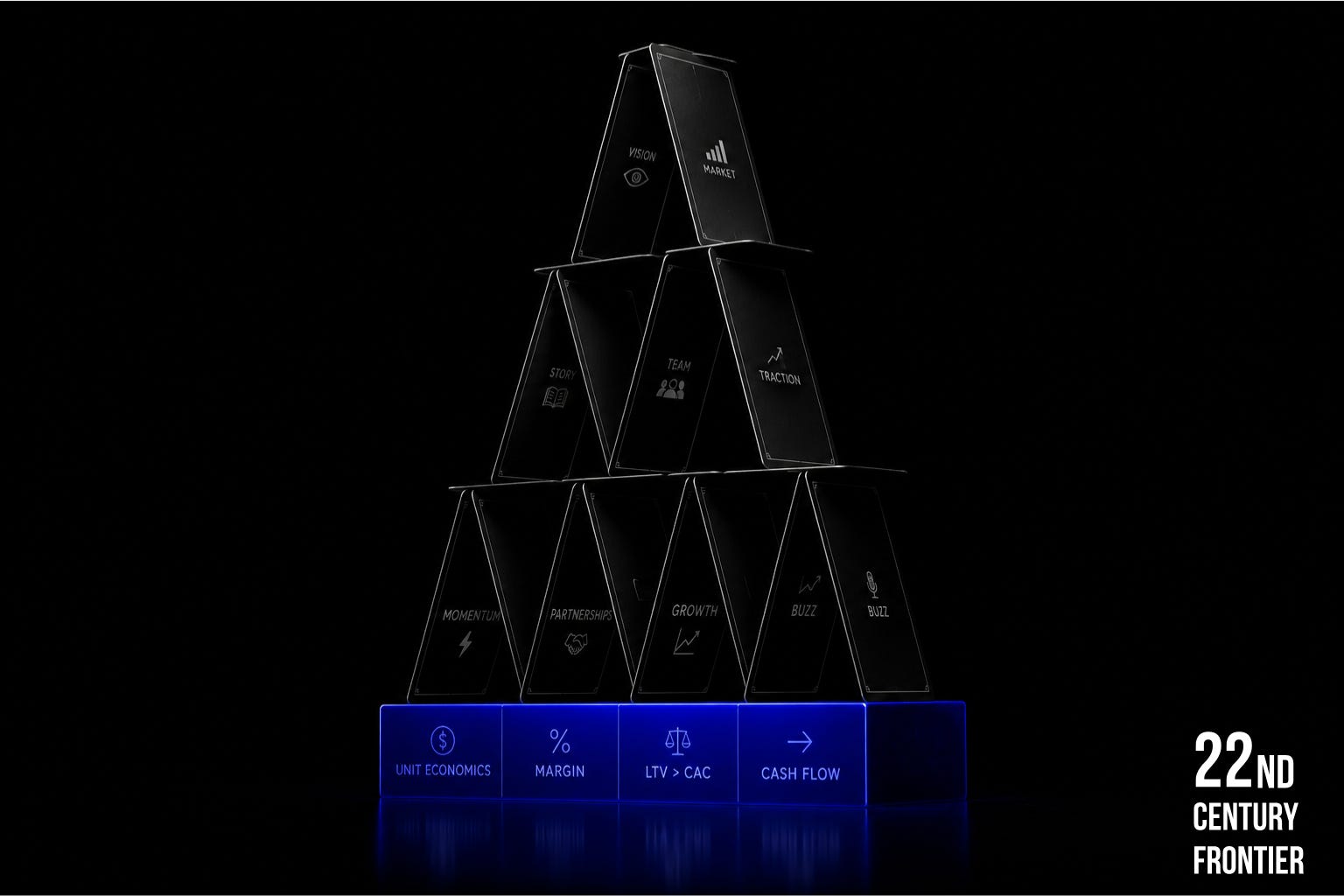
That is why most fundable businesses pass two tests.
The first is the narrative test.
The second is the numbers test.
You need both.
A business can sound exciting and still be structurally weak.
It can also look boring at first glance and still be one of the best companies in the room.
The job is not to impress people once.
The job is to build something that can survive scale, scrutiny, and a hard market.

Frontier Deal Flow 🎯
Companies struggle to reach the right investors. Investors struggle to find signal.
Frontier Deal Flow is a monthly curated database by 22nd Century Frontier, connecting high-quality companies with thousands of:
Angel investors, VC funds, corporate venture capital arms, venture syndicates, private equity firms, family offices, institutional investors, strategic corporate partners, and more.
Explore our latest Frontier Deal Flow issue.
Why submit:
• Get in front of serious investors actively looking for opportunities
• Share your raise in a clear, high-signal format
• Skip cold outreach
Submissions are completely FREE. For the May issue, submissions close 30 June, and the report goes live 1 July.
Key Takeaways
A fundable startup has to pass two tests:
The story must make sense, and the economics must hold up.
A strong narrative is not about sounding clever.
It is about being clear, believable, and specific.
The numbers test is stricter than the pitch test.
Growth means nothing if the unit economics break at scale.
Investors are not just backing momentum.
They are backing a business model that can survive scrutiny and repetition.
The best companies are coherent from both sides:
The market story feels inevitable, and the financial engine actually works.
Upgrade to premium and get the full 22nd Century Frontier experience.
Table of Contents
1. The Narrative Test
The narrative test is simple to describe and hard to fake.
Can someone understand your business quickly, believe why it should exist, and see why now is the right moment?
If the answer is no, you are not fundable yet.
You may still be interesting.
You may even have early traction.
But the story is not sharp enough.
This is where a lot of startups go wrong.
They describe a product, not a market.
They describe features, not inevitability.
They describe activity, not conviction.
A company that says it is building “AI for operations” is not passing the test by default.
That phrase could mean anything.
Is it software that automates repetitive admin?
Is it a human service wrapped in software?
Is it a workflow tool?
Is it a consulting business with a dashboard?
If the answer takes five minutes to explain, the market will move on.
A strong narrative does not mean exaggeration.
It means clarity.
The best stories usually have three things:
and a believable reason the company can win.
That is what investors are looking for.
Not poetry.
Not jargon.
Conviction.

A good narrative also has to respect human behavior.
If your model depends on customers changing habits too quickly, or enterprises abandoning old workflows overnight, or users suddenly caring about a problem they have ignored for years, the story gets weaker.
A better story makes change feel inevitable, not forced.
Think about a startup building software for independent clinics that reduces billing delays.
That is easy to understand.
The customer is clear.
The pain is clear.
The value is obvious.
The reason to buy is immediate.
Now compare that with a company that claims to be reinventing healthcare infrastructure, logistics, revenue capture, patient communication, and AI triage all at once.
That is not a narrative.
That is a fog machine.
Founders often think they need a bigger story.
Usually, they need a cleaner one.
2. The Numbers Test
The numbers test is less glamorous and far more important.
Can this business make economic sense at scale?
This is where pitch decks become much less useful and spreadsheets become extremely useful.
A business can have a beautiful story and still fail because every dollar of revenue costs too much to earn, support, or retain.
That is the part founders often discover too late.
Maybe customer acquisition is too expensive.
Maybe the product requires too much human labor.
Maybe churn is too high.
Maybe margins collapse as the business grows.
Maybe the company is basically buying revenue instead of earning it.
When that happens, growth stops being a signal of quality and starts becoming a faster route to failure.
A good business model should improve with scale, not just grow with it.
That distinction matters.
A subscription platform for niche professional training might make sense if retention is strong and acquisition is efficient.
But if each customer requires heavy sales effort, custom onboarding, and ongoing support just to stay active, the model may never become efficient enough to matter.
Same revenue.
Very different business.
A lot of founders confuse gross bookings, usage, and excitement with actual economics.
Investors do not.
They look at contribution margin, retention, payback period, and where the money really goes.
They want to know whether the company is building a machine or just renting momentum.

One of the cleanest ways to think about the numbers test is this:
If you put more fuel into the business, does the engine get stronger, or just hotter?
If more spend simply creates more loss, the model is broken.
If more spend creates better unit economics over time, there may be something real there.
That is why investors ask uncomfortable questions.
How much does it cost to acquire a customer?
How long does that customer stay?
How much do they pay?
How much does servicing them cost?
What happens when the market gets crowded?
What happens when paid growth slows?
These are not technical distractions.
They are the business.
3. The Best Models Pass Both Tests At Once
The strongest startups do not choose between a compelling story and sound economics.
They make both true.
That is the ideal.
The story explains why the company exists.
The numbers explain why it deserves to survive.
A founder building procurement software for mid-market manufacturers may start with a narrow use case.
The story is specific.
The buyer is obvious.
The pain is real.
The product can be adopted without asking the customer to reinvent the company.
If the business then expands through account growth, strong retention, and low marginal delivery cost, the numbers begin to support the narrative.
That is what fundable looks like.
Not flashy.
Not vague.
Just coherent.
A lot of impressive companies fail because they only pass one test.
Some are compelling but economically messy.
Some are efficient but forgettable.
Some are interesting in a pitch room but weak in the real world.
The best ones can be explained in one sentence and defended in ten spreadsheets.
4. What Founders Should Pressure Test Before Fundraising
Before you raise, ask two blunt questions.
Can I explain this business without hiding behind buzzwords?
Can I defend the economics without hand-waving?
If either answer is shaky, fix the model before you chase the round.
That may mean narrowing the wedge.
It may mean changing the customer.
It may mean dropping a feature that makes the story prettier but the business weaker.
It may mean admitting the economics only work in a different segment.
That is not failure.
That is strategy.
Investors are not looking for founders who have made everything perfect before the first check.
They are looking for founders who understand what is real, what is not, and what has to become true for the business to work.
That level of honesty is rare.
It is also fundable.

5. Final Thought
A fundable business is not just a good idea with momentum.
It is a story that makes sense and a model that survives contact with reality.
That is the whole game.
The narrative gets you believed.
The numbers get you backed.
The combination gets you built.
Most startups fail because they confuse one for the other.
The best founders do not.
They know the deck may open the door, but only the business model keeps it open.
Continue Exploring the Frontier
If this piece resonated, you may want to go deeper.
This article is part of our Capital Raising collection, where we explore the ideas, frameworks, and strategies that help founders, investors, and operators make better decisions.
You can also explore our main topic categories to discover more insights across entrepreneurship, venture capital, fundraising, company building, and frontier technologies.
If you are serious about shaping the future rather than reacting to it, you are exactly where you should be.
WHY SUBSCRIBE | PREMIUM RESOURCES | ENTERPRISE PLAN | ADVERTISE
So Crucial information! too many founders treat storytelling and unit economics as separate conversations. The strongest startups make them reinforce each other is the clear reason to exist and a business model that gets stronger as it scales. If either side breaks, the company eventually does too.
A story that needs five minutes to explain isn't a story.