


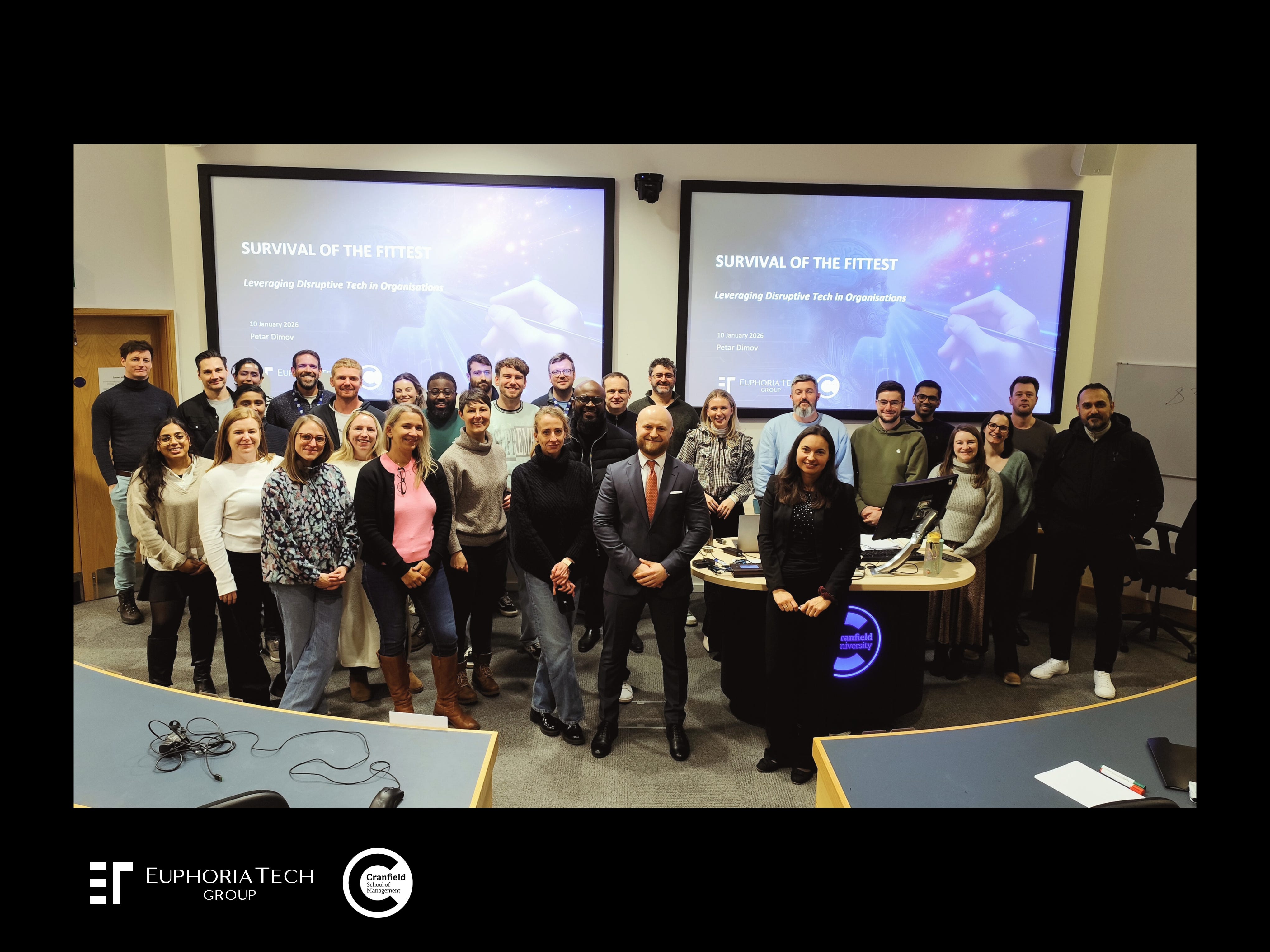
Last Saturday, I had the pleasure of spending the afternoon with the Executive MBA cohort at Cranfield School of Management, sharing reflections on practical implementation, corporate innovation, and how organisations can leverage disruptive technologies in real operating environments.
It was once again a great opportunity to discuss my experiences with C-level executives from Fortune 500 companies, leaders from European and Asian firms, private equity and venture capital funds, as well as founders from start-ups and scale-ups, alongside insights from my entrepreneurial journey and our work at EuphoriaTech Group.
After the session, one of the students stayed behind for a short conversation. His question was simple and honest:
“How do I actually land my first customers?”
My answer to him was equally simple:
It is a numbers game.
At the earliest stage, progress does not come from perfect strategy or polished messaging.
It comes from putting yourself in front of enough real people, learning quickly, and being willing to do the uncomfortable work that cannot scale.
Then yesterday, a friend of mine, a Substack legend in his own right, just landed his first paid subscriber. The note from his new supporter was short and powerful:
“You’re The Best!”
That is the kind of message every founder, writer, or builder wants to receive.
Not because of the money, but because it signals something far more important:
Someone cared enough to commit.
Those two moments are what prompted me to write this.
What follows is a practical perspective on how to get your very first customers when you have no traction, no brand, and no momentum.
Not in theory.
In reality.
Everyone loves polished growth tactics. Funnels. Paid acquisition. “Scalable channels.”
But none of that matters when you have zero customers.
The truth most founders avoid is simple:
Your first traction will come from actions that feel awkward, inefficient, and unglamorous.
Not because you are doing it wrong, but because that is how early progress actually happens.
This is a guide to getting your first real users, not your first pitch deck compliments.
Key Takeaways
Your first customers will not come from scalable tactics
Early traction is created through manual, personal, and often uncomfortable actions. That is not inefficiency. That is validation.If you cannot convince one person, no growth system will save you
Before funnels, ads, or automation, you must prove that a real human cares enough to use or pay for what you are building.Non-scalable work is how you learn what actually matters
Direct outreach, personal onboarding, and hands-on delivery expose objections, motivations, and product gaps faster than any dashboard.Small numbers are an advantage, not a weakness
When you have five customers, doubling is achievable through effort. Momentum at this stage comes from action, not optimization.You earn the right to scale only after you create demand
Automation comes later. First, prove that people want the solution badly enough to say yes without marketing machinery.
Table of Contents
Introduction: Why Your First Customers Never “Just Appear”
What “Doing Things That Don’t Scale” Actually Means
Why This Phase Is the Most Important Stage of a Startup
A Real-World Example of Traction Without Systems
Stop Waiting for Perfect Strategy
Where Your First Customers Really Come From
The One-Week Traction Test
A Different Kind of Case Study
Learning Faster Through Manual Growth
What To Do This Week
When to Transition From Hustle to Systems
The Hard Truth
Final Thought: Earn the Right to Scale
1. The Myth of “Launch and They Will Come”
Many first-time founders secretly believe that a good product attracts users automatically. Build something clever, put it online, and wait for traction to appear.
That rarely happens.
What actually happens is quieter and more uncomfortable:
Founders manually pull the first few people into the product, one at a time.
They do things that feel more like hustle than strategy. They substitute automation with effort until there is enough signal to justify systems.
The early days are not about efficiency.
They are about proof.
2. What “Non-Scalable” Really Means
Non-scalable actions are any activities that cannot be repeated forever but create momentum now.
This can look like:
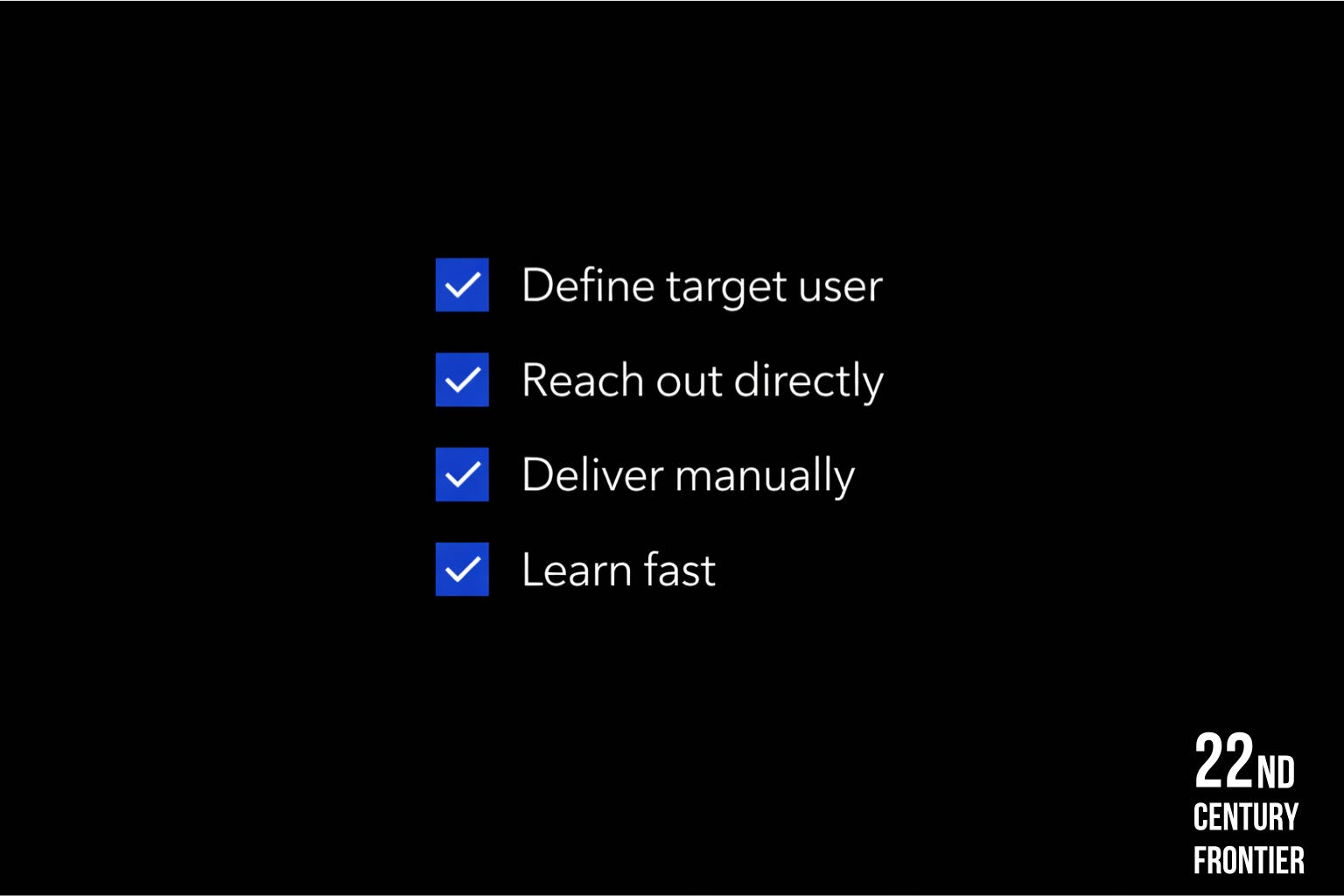
Personally onboarding each user over video
Manually creating accounts for customers
Writing individualized messages instead of marketing campaigns
Delivering a service yourself before building software around it
Customizing the product for early users instead of building generic features
It is not pretty. It is effective.

3. Why This Phase Matters More Than You Think
At zero or near-zero customers, every action has outsized impact.
If you have 5 users, getting 5 more is a 100 percent increase.
If you have 20 users, landing 10 more changes your entire dataset.
This is the only phase where doubling is trivial if you are willing to do what others will not.
Yet most teams skip it.
They talk about “brand strategy” and “growth models” while their product has not yet proven that anyone actually wants it.
4. A Realistic Example: Selling Without Scale
Imagine a two-person team building a scheduling tool for freelance videographers.
They have:
A basic landing page
No paying users
No ad budget
A few demo screens
The scalable path would be:
“Let’s test ads once we refine positioning.”
The effective path is different.
They identify 50 freelance videographers in one city.
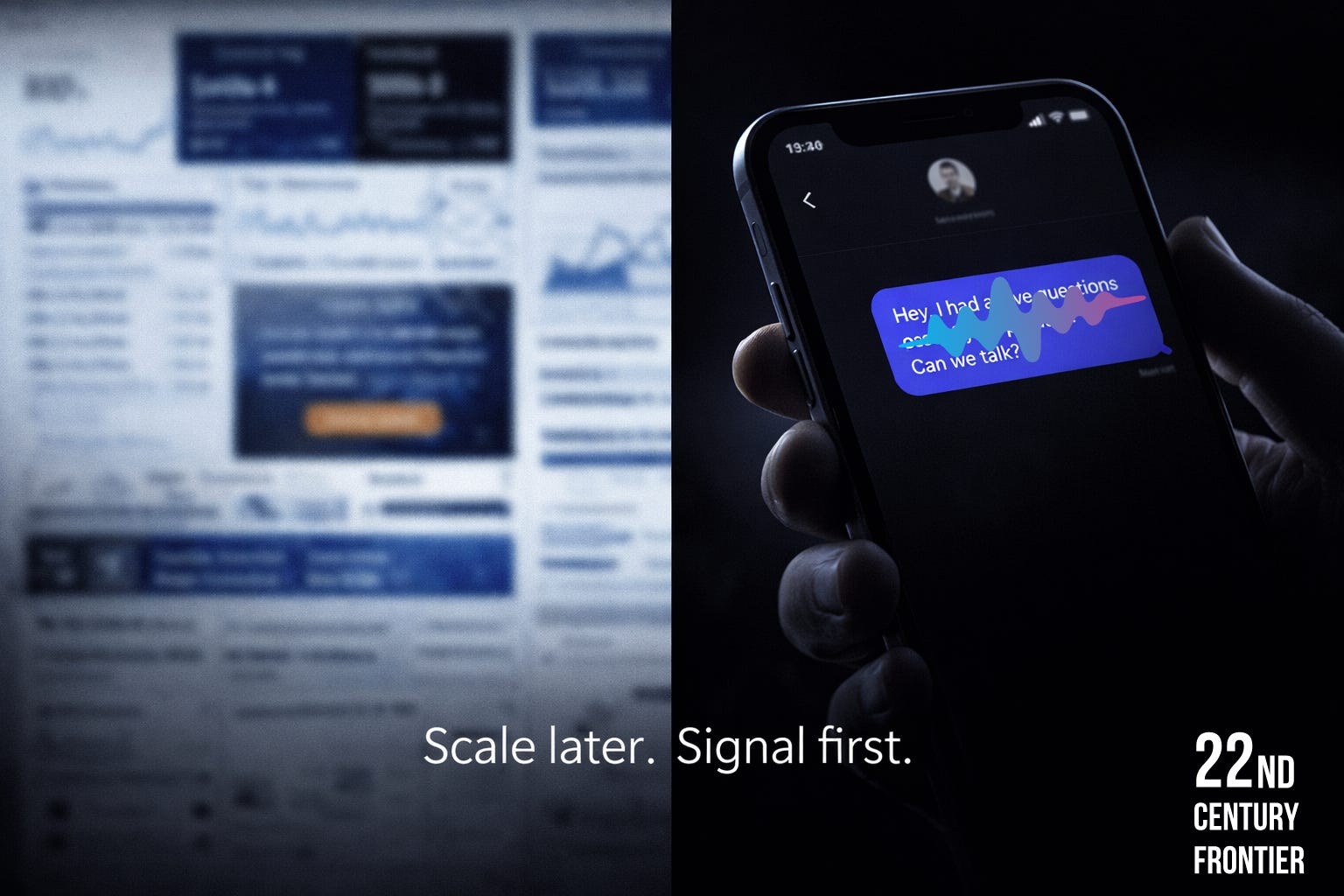
They send direct messages offering to personally set up the tool for their next client project.
They offer to manually import their bookings and customize workflows.
It is slow.
It is awkward.
It works.
Three say yes.
One becomes a paying customer.
Two give detailed feedback that reshapes the product.
This is not growth hacking. This is traction by effort.
5. Stop Waiting for Permission From “Best Practices”
Founders often delay action because what they are considering does not feel “startup-like.”
“This isn’t how real SaaS companies acquire users.”
“This won’t work at scale.”
“We should focus on automation.”
Those thoughts belong to a later stage.
Right now, you are not optimizing.
You are discovering.
The only question that matters:
Can you convince a real human to care?
If the answer is yes, you have something.
If not, no funnel will save you.
6. Your First Customers Will Not Arrive Politely
Your first users will come from:
Uncomfortable outreach
Personal networks you would rather not tap
Manual effort you hoped to avoid
Situations that feel more like sales than innovation
This is not a failure of vision.
It is the cost of validation.
7. A Simple Test: Could You Double This Week?
Ask yourself:
How many customers do we have today?
What is the fastest method to get that same number again?
Not the prettiest method.
Not the scalable method.
The fastest.
If the answer is “I could walk into five offices tomorrow” or “I could message 30 people directly” or “I could onboard users manually,” then you already know what to do.
Most founders simply do not want to do it.

8. A Different Kind of Case Study
A solo founder launches a niche analytics dashboard for independent Shopify merchants.
Instead of:
Writing SEO content
Running ads
Building integrations
They do this:
Join two private e-commerce Slack communities.
Respond to threads where merchants complain about tracking issues.
Offer to build a custom dashboard manually for their store.
Ask for feedback after two weeks.
They gain:
Four beta users
Two paying customers
A clear understanding of what features matter
No campaign.
No funnel.
Just effort.
This is the phase where product-market fit begins to reveal itself.
9. The Hidden Benefit: You Learn Faster Than Your Competitors
When you manually recruit and onboard users, you gain something most teams do not:
You hear objections in real time
You see where people get confused
You learn what they actually value, not what they say they value
This feedback is impossible to get from analytics alone.
Non-scalable work is not just about sales.
It is about clarity.
10. What To Do This Week
If you are early-stage, here is a direct challenge:
Write down your current number of active users or customers.
Identify the fastest possible way to reach that same number again.
Commit to doing it within seven days, regardless of how uncomfortable it feels.
Examples:
Walk into ten local businesses and offer a live demo.
Message 50 people in a niche online group with a personalized pitch.
Manually deliver your service for the next five users.
Offer white-glove setup in exchange for honest feedback.
Do not optimize yet.
11. When To Stop Doing Things That Don’t Scale
You do not stay in this phase forever.
You transition when:
Demand exceeds your ability to manually support it
Patterns in acquisition start to repeat
Your time becomes the bottleneck
That is when you automate. That is when you design funnels. That is when you invest in systems.
Not before.
12. The Hard Truth
Most early startups do not fail because their ideas are bad.
They fail because founders wait for traction instead of forcing it into existence.
They stay in the office.
They refine decks.
They plan “growth strategies.”
Meanwhile, the market remains silent.
Momentum does not arrive on schedule.
It responds to action.
13. Final Thought: Earn the Right to Scale
You do not deserve automation before you have proof.
You do not need elegance before you have customers.
Your first wins will be messy.
Your early tactics will feel unprofessional.
Your process will not look like a case study.
That is exactly why it works.
Before you worry about scale, go earn one customer.
Then another.
Then another.
Only after that does growth become a systems problem.
Until then, it is a courage problem.
Continue Exploring the Frontier
If this piece resonated, you may want to go deeper.
Here are three recent articles readers found especially useful:


Each one tackles a different part of the same challenge: building with intent, not hope.
If you are serious about shaping the future rather than reacting to it, you are exactly where you should be.
WHY SUBSCRIBE | PREMIUM RESOURCES | ENTERPRISE PLAN | ADVERTISE
The second point around 'non-scalable' is really interesting.
You mention momentum and effectiveness already, and I would also add to this that these manual, in-the-trenches type activities will generate invaluable insights about your customers, product feedback, processes and so on.
Enjoyable article with lots of words of wisdom in it! Great job.
Spot on. 'If you can't convince one person, no funnel will save you.'
I'd add one nuance: The Concierge MVP.
Don't just 'sell' manually; 'deliver' manually. The best founders I know didn't just find customers by hand; they were the software for the first 6 months.
That feedback loop is tighter than any analytics tool.