


Last week, we published the Series A Edition of the VC Due Diligence Prompt Playbook, focused on PMF validation and GTM repeatability.

This week, we’re releasing the Series B+ Edition, the final guide in our three-part series.
Series B+ diligence is different from early-stage rounds:
The data exists, and the challenge is testing whether it holds up under rigorous, multi-dimensional analysis.
Series B+ diligence is not harder than early-stage diligence.
It is different in one crucial way.
At seed, a founder and a compelling thesis can justify risk when data is thin.
At Series B and beyond, the data exists.
The question becomes whether that data holds up under rigorous examination.
Too often, investors stop at headline metrics.
ARR, growth rate, and logo count tell you little about quality.
Is ARR sticky or at risk?
Is growth compounding or decelerating?
Is the competitive moat deepening or eroding as the company scales?
Standard growth-stage diligence focuses on top-line signals and valuation triangulation.
What it misses is quality.
Those headline metrics require multi-dimensional testing to evaluate durability and defensibility.
Key Areas for Rigorous Series B+ Analysis
Unit economics
Unit economics must show improvement at scale, not just health at a point in time. A sustained burn multiple above 3x is a red flag. It may be justified in rare cases with a clear path to profitability, but it should never be treated as a default excuse.
Competitive moat
A moat assessment must go beyond “switching costs exist.” Ask whether moats are deepening as the company scales and whether growth exposes it to larger incumbents who previously ignored it.
Financial model
Request a 3-statement model with monthly granularity for 24 months, explicit assumptions for revenue drivers, and scenario analysis. The model must show a credible path to profitability and a conservative bear case that demonstrates runway and capital requirements.
Exit analysis
Map the acquirer universe, IPO comparables, and objective readiness criteria. If neither M&A nor IPO looks plausible on reasonable assumptions, that limits the investment thesis.
The Playbook Solution

The 22nd Century Frontier VC Due Diligence Playbook - Guide 03: Series B+ gives you 11 prompts engineered for this level of rigor.
Weighted 60% on unit economics, scalability, and competitive moat; 40% on market expansion and exit optionality.
Every prompt specifies:
Inputs
Expected outputs
Benchmarks to verify
How to chain results into the next step
These prompts are designed to surface gaps in the data, not paper over them. Vague inputs produce flagged outputs, so weaknesses become visible immediately.
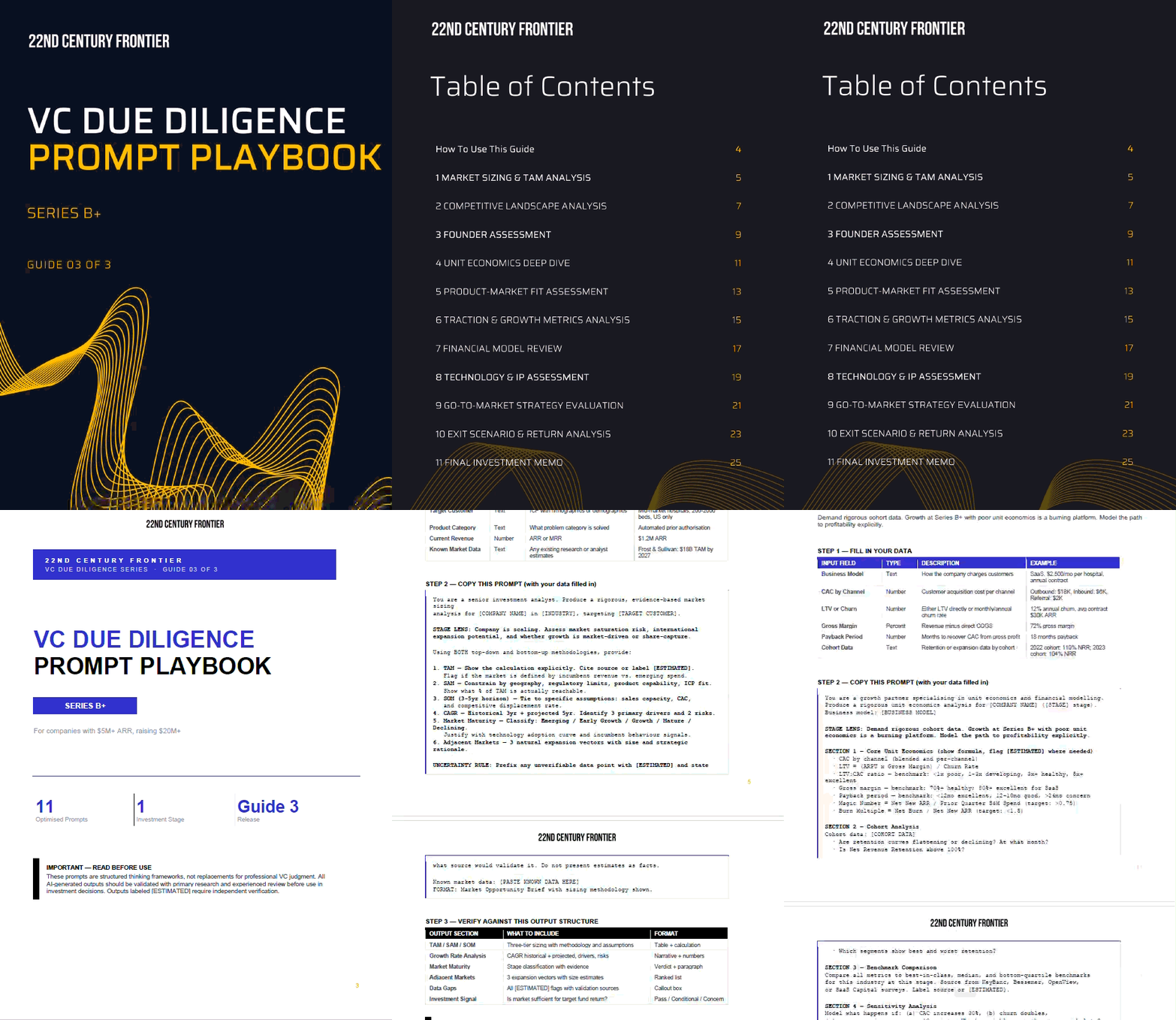
What’s inside:
✅ 11 prompts calibrated for Series B+ analysis
✅ Unit economics cohort analysis with NRR trend evaluation
✅ Competitive moat deepening/erosion assessment
✅ 3-statement financial model audit framework (monthly granularity)
✅ Capital efficiency benchmarking and burn multiple guidance
✅ IPO readiness criteria and M&A acquirer tiering
✅ Probability-weighted return scenarios and final investment memo template
How to use it
Fill in the input data
Run each prompt and verify outputs
Chain results to produce a complete, institutional-grade diligence file
This is the final guide in the three-part series:
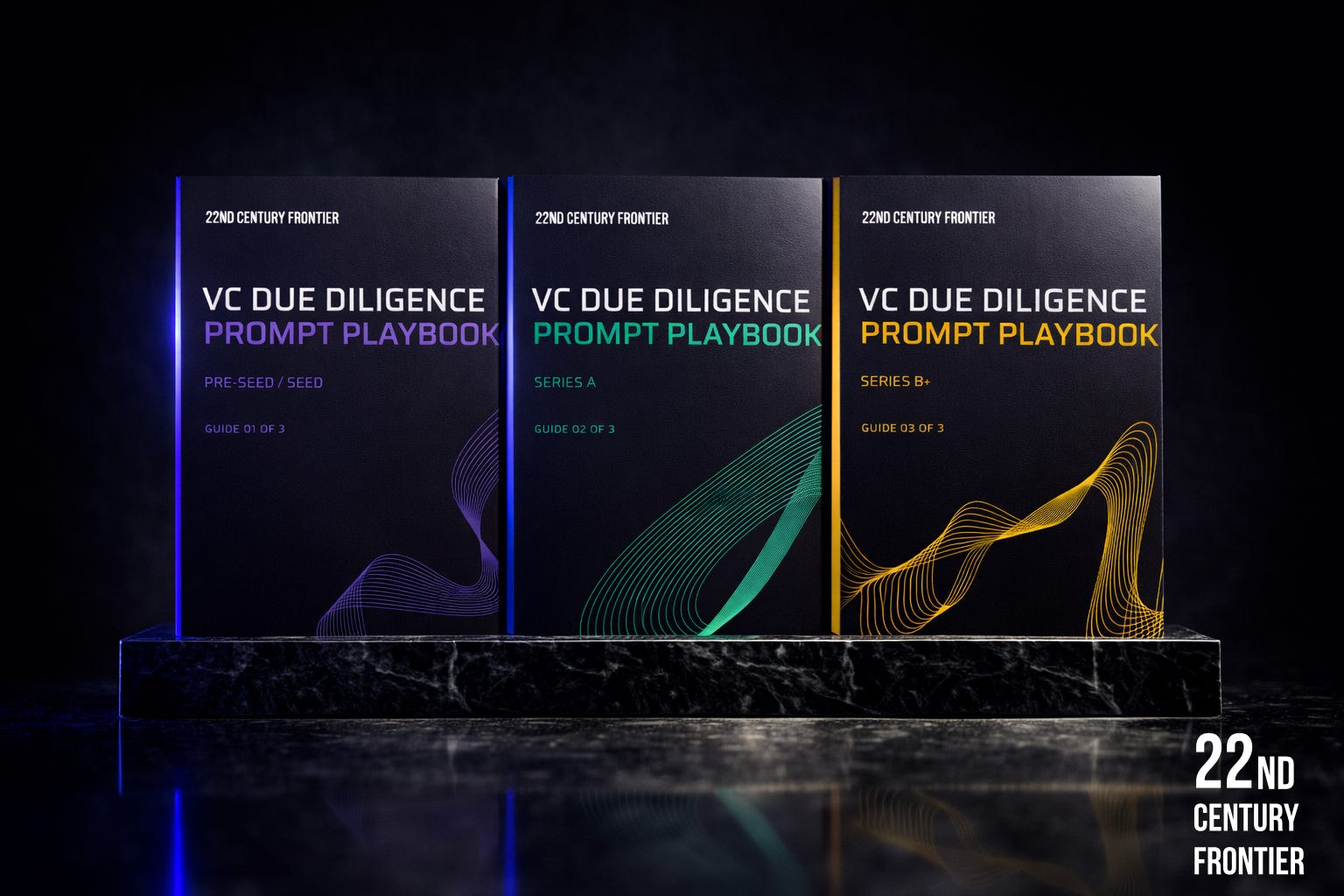
Guide 01: Pre-Seed / Seed - founder-led, thesis-heavy analysis
Guide 02: Series A - PMF validation and GTM repeatability
Guide 03: Series B+ - quantitative rigor and exit clarity
Run the three guides sequentially on any deal, and you have a complete, evidence-based due diligence workflow.
