


Most startup decks do not fail because the product is bad.
They fail because the story is unclear.
Investors do not need poetry.
They need a reason to care, a reason to believe, and a reason to lean in.
The Story Spine is useful because it gives founders a clean way to move from problem to opportunity without sounding scattered, vague, or overworked.
At its best, it turns a pitch from a list of features into a narrative with momentum.

Frontier Deal Flow 🎯
Companies struggle to reach the right investors. Investors struggle to find signal.
Frontier Deal Flow is a monthly curated database by 22nd Century Frontier, connecting high-quality companies with thousands of:
Angel investors, VC funds, corporate venture capital arms, venture syndicates, private equity firms, family offices, institutional investors, strategic corporate partners, and more.
Explore our latest Frontier Deal Flow issue.
Why submit:
• Get in front of serious investors actively looking for opportunities
• Share your raise in a clear, high-signal format
• Skip cold outreach
Submissions are completely FREE. For the next issue, submissions close 30 July, and the report goes live 1 August.
Key Takeaways
Great startup pitches do not begin with the product. They begin with a problem worth solving.
The Story Spine gives your pitch a clear narrative that makes investors care before you ask them to believe.
Every section of your deck should move the story forward, from the customer’s world to your traction and vision.
Strong storytelling is not about sounding creative. It is about making complex ideas easy to understand and remember.
Investors fund businesses they can clearly imagine succeeding. A compelling narrative helps them see that future.
Upgrade to premium and get the full 22nd Century Frontier experience.
Table of Contents
1. Why The Story Spine Works
The best startup stories are not built around the founder.
They are built around a world that has changed, a customer who feels the pressure, and a company that arrives with the right answer at the right time.
That is what the Story Spine helps you do.
It gives your pitch a beginning, a shift, a struggle, a solution, and a resolution.
In other words, it gives your audience something their brains can follow.
And when investors can follow the story, they are far more likely to remember the company.
2. The Structure
The classic version is simple:
Once upon a time
Every day
One day
Because of that
Until finally
And ever since that day
You do not need to say those exact words in a deck.
The point is to use the logic behind them.
Think of it like this:
Once upon a time introduces the world
Every day shows the pain
One day creates the change
Because of that explains your response
Until finally shows traction or proof
And ever since that day paints the future
That is the backbone.
Everything else is just support.
a. Once Upon A Time: Set The World
This is where you establish the market.
Not your company.
The world your customer lives in.
What does that industry look like today?
What is broken?
Why is this problem worth solving now?
A strong opening does not try to say everything.
It gives investors enough context to understand the pressure in the system.
For example, imagine a startup that helps industrial maintenance teams prevent unplanned equipment downtime.
The opening is not about the software.
It is about the reality that factories lose money every time a machine breaks, schedules slip, or a repair comes too late.
That is the world.
That is where the story begins.
b. Every Day: Show The Pain
Now you show what daily life looks like without your solution.
This is where founders often get too abstract.
They talk about a market opportunity, but not the actual experience of the customer.
That is a mistake.
You want the investor to feel the friction.
In the industrial example, every day might look like this:
A maintenance lead is juggling spreadsheets, emails, phone calls, and old equipment logs.
A technician notices a warning sign too late.
A small issue becomes a production delay.
A delay becomes revenue lost.
A workaround becomes the norm.
That is not just a workflow problem.
It is operational drag.
The more clearly you show the pain, the more obvious your startup becomes.
c. One Day: The Shift Happens
This is the moment the story changes.
Something has to force the old system to look outdated, fragile, or slow.
That could be:
A new technology.
A regulation.
A market shock.
A new customer expectation.
A shift in behavior.
Or simply the fact that the old way has finally become too expensive.
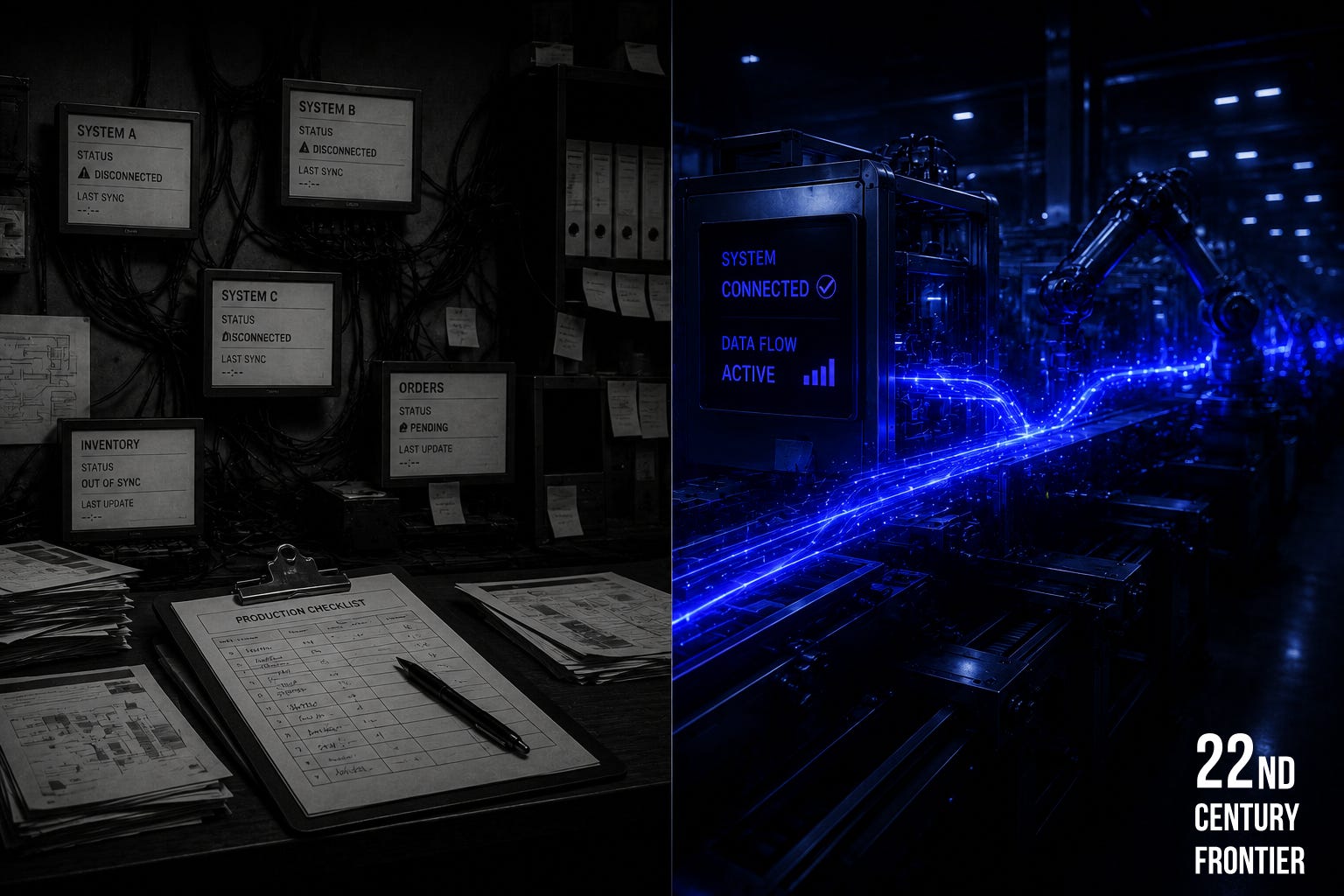
In the industrial maintenance example, the shift might be this:
Sensors are cheaper.
Data is available in real time.
Equipment owners can no longer afford reactive maintenance.
The old manual approach no longer scales.
Now there is a reason for change.
That is where your company enters the story.
d. Because Of That: Explain What You Built
This is the execution part of the story.
Because the world changed, you built something that works better.
Because the problem is urgent, your solution matters.
Because the customer needs speed and clarity, your product is designed around that reality.
This is where you explain the team, the product, the edge, and the reason now is the right time.
For example:
Because machine failure is costly, you built software that predicts issues earlier.
Because operations teams are overloaded, you made it simple to deploy.
Because the buyer needs trust, you built reporting that is easy to understand.
Because the pain is recurring, the product becomes sticky.
That is far stronger than saying, “We use AI.”
Investors do not fund buzzwords.
They fund relevance.
e. Until Finally: Show Proof
A story without proof is just a pitch.
This is where traction enters.
Not every company will have huge numbers yet.
That is fine.
Traction is not only revenue.
It can also be pilots, usage, retention, paid trials, customer referrals, conversion, or a narrow but meaningful proof point that shows the market wants what you built.
The point is to show that the story is not hypothetical.
It is already happening.
In the industrial example, proof could look like this:
Several plants are already using the product.
Downtime is falling.
Maintenance teams are saving hours.
A second facility wants in.
A pilot is converting into a broader deployment.
That is the moment the deck stops being abstract.
Now there is evidence.

f. And Ever Since That Day: Paint The Future
This is where you show what changes if the company succeeds.
The future should feel bigger than the product.
It should feel inevitable, useful, and worth funding.
In the example above, the future is not “we sell software.”
The future is that factories waste less money, teams act earlier, plants run cleaner, and industrial operations become more intelligent over time.
That is the real story.
If you can make the investor see the before and after, you have done the hard part.
The company is no longer just a startup.
It is the answer to a structural problem.
3. A Simple Way To Use This In Your Deck
Use the Story Spine to shape the first half of the pitch:
World
Pain
Change
Solution
Proof
Future
That gives your deck a logical arc and keeps you from jumping too quickly into features, metrics, or random slides that do not earn their place.
The mistake most founders make is opening with the product.
The better move is to open with the problem that made the product necessary.
That is what makes investors care.
4. Final Thought
A good pitch is not a monologue about your startup.
It is a story about a broken world, a meaningful shift, and a company that is built to do something about it.
The Story Spine helps you stay honest, clear, and memorable.
Not polished for the sake of polish.
Clear for the sake of conviction.
And in fundraising, clarity is not a cosmetic choice.
It is leverage.
Continue Exploring the Frontier
If this piece resonated, you may want to go deeper.
This article is part of our Pitch Decks collection, where we explore the ideas, frameworks, and strategies that help founders, investors, and operators make better decisions.
You can also explore our main topic categories to discover more insights across entrepreneurship, venture capital, fundraising, company building, and frontier technologies.
If you are serious about shaping the future rather than reacting to it, you are exactly where you should be.
WHY SUBSCRIBE | PREMIUM RESOURCES | ENTERPRISE PLAN | ADVERTISE
The “don’t open with the product” point is the one founders keep learning the hard way.
Nobody cares about the clever tool until they understand the expensive, annoying, recurring problem it’s meant to kill.
Opening with the problem instead of the product is the mistake most decks never fix.