

The Art of VC Rejection: How Smart VCs Turn Rejections Into Reputation Capital ✉️
Guide for investors to write rejection emails that scale and leave founders feeling respected

Saying no is day job material for early-stage investors.
The art is not in the refusal.
The art is in how you refuse.
Done well, rejection becomes brand building.
Done badly, it becomes a viral rant and a long tail of sour reputations.
Below is a short framework, a ready-to-use template, and practical ways to scale thoughtful replies without wasting partner time.

Frontier Deal Flow 🎯
Companies struggle to reach the right investors. Investors struggle to find signal.
Frontier Deal Flow is a monthly curated database by 22nd Century Frontier, connecting high-quality companies with thousands of:
Angel investors, VC funds, corporate venture capital arms, venture syndicates, private equity firms, family offices, institutional investors, strategic corporate partners, and more.
Why submit:
• Get in front of serious investors actively looking for opportunities
• Share your raise in a clear, high-signal format
• Skip cold outreach
Submissions are completely FREE. For the March & April issue, submissions close 30 April, and the report goes live 1 May.
Key Takeaways
How you reject founders shapes your reputation.
Every interaction spreads through the startup ecosystem. A respectful rejection today can turn into referrals, deal flow, or a future investment opportunity.Clarity beats politeness without substance.
Founders prefer a direct “no” with a concrete reason and milestone over vague “maybe later” responses that waste time and energy.Understanding creates long-term optionality.
Acknowledging the difficulty of fundraising and treating founders like peers builds goodwill that can pay off years later.Specific milestones keep the door open without wasting time.
When investors explain exactly what traction would change their decision, founders know whether it is worth coming back.A simple structured template lets VCs respond at scale without sounding robotic.
With just a few personalized elements, investors can maintain a human tone while efficiently handling hundreds of pitches.
Table of Contents
1. Why Courteous Rejections Matter
Word of mouth shapes deal flow. Founders share stories, and a small negative moment spreads fast.
You want founders to come back. Today’s “no” can be tomorrow’s “yes” if the founder remembers you as reasonable.
Your brand is every interaction you have. Each respectful reply is free, high-quality PR.
2. Core Principles For Rejection Emails
Keep these five rules front of mind when replying.
Timely
Reply within 24–48 hours when possible. A fast, considered response signals attention and respect.
Clear
Say “no” plainly. Ambiguity causes founders to chase ghosts. Follow the no with one short reason.
Kind and human
Acknowledge the founder’s work and risk.
Actionable
Give one concrete way the founder could come back that you would take seriously. Numbers or clear milestones are best.
Concise
Founders are emotionally invested and short on time. 5–7 sentences usually suffice.
3. What A Positive Rejection Does For Founders
Confirms you read the deck and respected their time.
Gives a clear signal about your concerns so the founder can decide what to fix.
Keeps the relationship alive for follow up if milestones are met.
Avoids toxic word of mouth across founder networks.
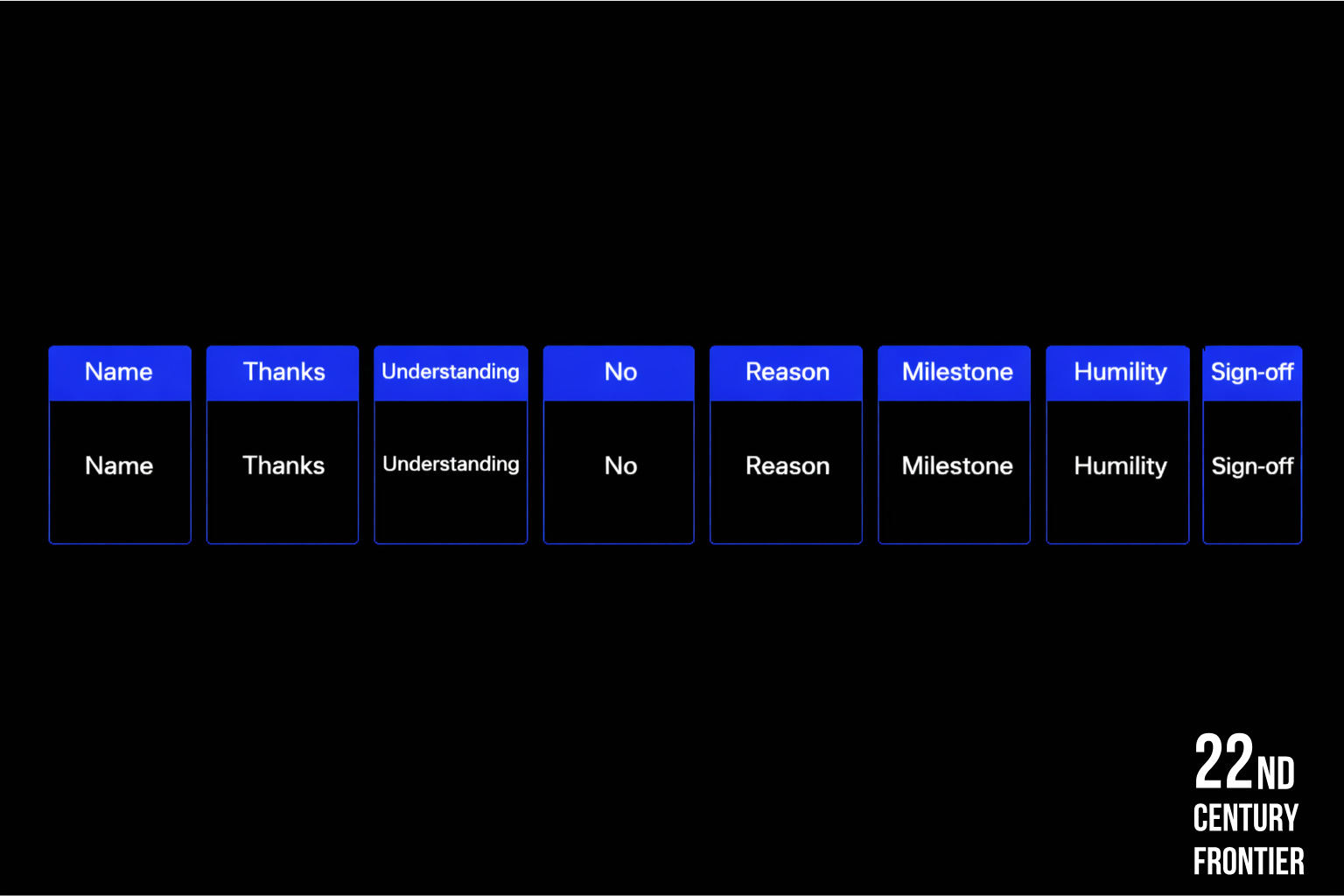
4. The Anatomy Of A Great Rejection Email
Keep it short, scannable, and specific.
Include these elements:
Personal salutation using the name they used in their signature.
A quick thank you for their outreach.
One sentence of understanding or shared experience.
A crisp, explicit No for now. Use “we” if you are speaking for the fund.
One specific reason you passed, framed as an actionable gap.
A clear milestone to trigger re-engagement, expressed as a number or outcome.
A humble caveat - acknowledge you might be wrong.
Offer a single, small piece of useful direction only if you have it.
Sign off with your casual name. No corporate flourish.
5. Practical Examples And Phrases To Use
Good concise language that founders actually read.
Clear No:
“For the purposes of our pacing and focus, this is a no from us at the moment.”Actionable reason:
“My main concern is distribution. Your CAC assumptions look optimistic given the channel mix.”Milestone to reopen:
“If you reach $600k ARR with a CAC payback under 9 months, please ping me and I will review again.”Humble close:
“I could be wrong here, and I would be glad to be shown otherwise.”
6. Short Example Template You Can Use
Replace bracketed fields before sending.
Hi [First name],
Thanks for sending [Startup name] and for thinking of [Fund name]. I’ve been a founder and know how much work this takes.
For the purposes of our investment focus this year, it is a no from us. My main concern is [brief reason - e.g., channel concentration, early churn, team gaps]. That said, I might be missing something. If you hit [specific milestone, e.g., $750k ARR], please reach out and I will take another look.
Wishing you the best with this round, and thanks again for the intro.
[First name]
7. How To Give A Reason That Lets Founders Save Face
Avoid saying the team is weak.
Instead pick signals founders can fix or show progress on:
Traction numbers - ARR, MRR, DAU, conversion, churn.
Business model proof points - gross margin, payback period.
Lead investor or anchor commits.
Technical validation - pilot customers, integrations, regulatory signoffs.
Good safe reasons:
Market size uncertainty
Lack of evidenced traction
Distribution economics
Category fit
These are concrete and fixable.
8. Scaling This Without Sounding Robotic
Build 3-4 tight templates for the 80 percent cases - early traction, pre-revenue, non-core domain, syndicate follow.
Keep 2-3 editable fields: founder name, startup name, the one-sentence reason, milestone.
Use an email snippet or short macro so partners can personalize fast.
Track follow-ups with a simple CRM tag: “reopen-if” and the milestone attached.
9. Parting Thought
Saying No is part of the job.
Saying no badly is optional.
If you treat founders like humans, your firm will be remembered for fairness not for gatekeeping.
One thoughtful email can keep a founder in your orbit for their next, much bigger, company.

Continue Exploring the Frontier
If this piece resonated, you may want to go deeper.
Here are three recent articles readers found especially useful:


Each one tackles a different part of the same challenge: building with intent, not hope.
If you are serious about shaping the future rather than reacting to it, you are exactly where you should be.
WHY SUBSCRIBE | PREMIUM RESOURCES | ENTERPRISE PLAN | ADVERTISE
How you treat people on the way out always comes back around.
Turning thoughtful VC rejections into reputation capital is smart strategy for lasting relationships.