


Shipping sooner is conventional startup advice.
The less-discussed truth is this:
Time itself is an asset you can spend or squander.
If extra months of polishing will not move you into a new valuation bucket, you are destroying optionality.
Launch to capture the value of time, then use capital to buy speed.

Sponsor Highlight: EuphoriaTech Group ✨
Where founders, executives, and top creators connect
EuphoriaTech Academy is a community-first membership giving you access to Influencer Syndicate Communities and a Founder & Executive Network.
Collaborate, share insights, and build real opportunities with people actively shaping tech and business.

Key Takeaways
Time is a founder’s most undervalued asset. Delaying launch often destroys more opportunity than launching imperfectly because progress is measured by traction, not polish.
Valuation jumps happen at stage shifts, not feature additions. Investors care more about which milestone bracket you are in than how many months you spent building.
A Minimum Desirable Product beats a bare MVP. Slightly better presentation and clarity can unlock referrals, trust, and investor interest.
Fundraising is a speed multiplier. Capital is not validation. It is fuel that lets you learn faster, hire sooner, and test more hypotheses at once.
Shipping early is a strategic move, not a hustle cliché. Launch timing should be calculated based on whether waiting changes outcomes. If it does not, ship now.
Table of Contents
1. The Hidden Calculus: Time Versus Perceived Value
Founders usually argue about building the perfect product or validating more features.
Both matter, but they miss a simple economic fact:
Early-stage valuations are heuristic-driven
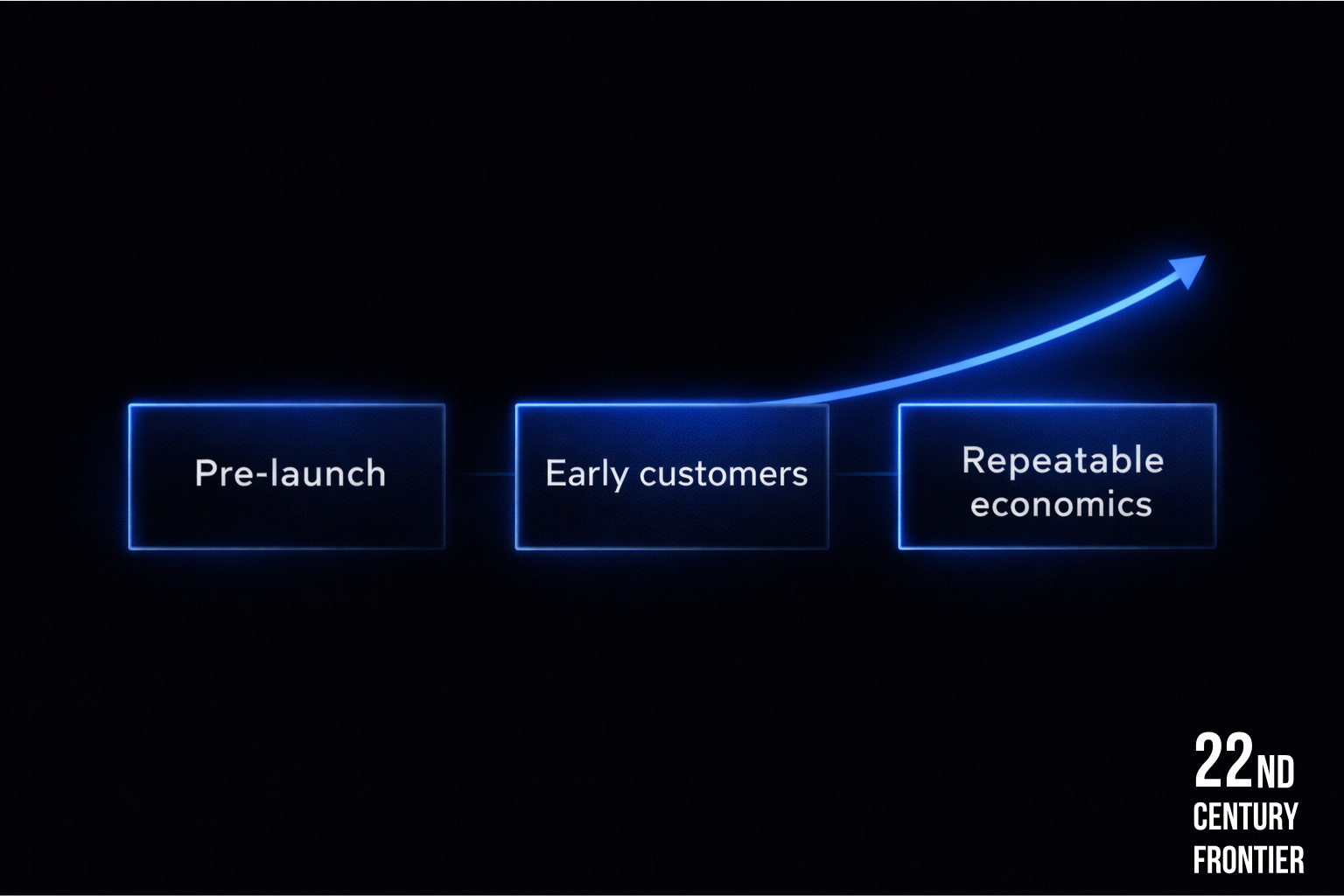
Investors categorize startups into crude boxes such as pre-launch, early customers, repeatable revenue.
Moving from one box to the next is what meaningfully changes your valuation, not incremental polish.
Imagine a team that spends 18 months polishing their analytics engine in stealth.
They create beautiful code, but still have zero customers.
When they finally show up, investors still see “pre-revenue” and assign the same valuation range as before.
The founders have spent precious time when they could have been building traction or speaking to investors who could have accelerated growth.
Time has an opportunity cost.
Every month you delay launching is a month you do not have to hire, learn from a larger sample of users, pivot fast, or raise.
The math is simple:
If three months of extra dev work will not move you into a new “box”, ship now.
2. MVP Is Useful. MDP Is Often Smarter
Minimum Viable Product (MVP) remains a useful concept.
But in practice I recommend aiming for a Minimum Desirable Product (MDP) when you plan to show it publicly or to investors.
MDP means the product is stable, communicates value clearly, and feels polished enough to induce trust and referrals.
Example:
An EdTech team built a basic quiz engine and launched.
Their initial MVP got signups but no referrals.
They reworked the onboarding, built a clean landing page, added a short demo video and simple payment flows, then relaunched.
That small upgrade to MDP produced word-of-mouth referrals and a handful of paying customers.
That was the moment investors began to take meetings.
MDP lowers friction and raises perceived quality.
It still keeps development lean, but it maximizes your chance of turning early users into advocates.

3. Raise Earlier To Buy Runway And Learning Velocity
One core reason to raise once you reach MDP:
Money is a multiplier for time.
Hiring two engineers, a growth lead, and a customer success person transforms what you can learn in six months.
You convert serial, slow experiments into parallel learning loops.
Example:
A mobility startup raised a modest seed right after demonstrating strong engagement with 50 fleet managers.
With that seed, they hired ops staff and scaled outreach.
Within four months they tripled retention and showed a clean user cohort that justified a higher seed valuation.
Had they kept building alone, time and morale would have eroded instead.
Raising early is not about vanity.
It is about leverage.
If fundraising conversations show investor interest, use that signal.
Ask for advice, then for capital when your signal is measurable.

4. How Valuations Actually Move
Valuations change when you change the story investors can believe.
The typical ladder:
Pre-launch: prototypes, pitch decks. Valuations driven by team reputation and comparables.
Early customers: first paid customers, solid engagement metrics. Valuation step up.
Repeatable economics: unit economics validated, scalable channel found. Larger step up.
Extra polish will not move you from pre-launch to early customers.
Only measurable user behavior will.
So launch early enough to collect those behaviors.
5. A Practical Launch Playbook To Maximize Time Value
Ship MDP, not a feature soup. Make the value proposition obvious within 5 seconds.
Prepare a crisp landing page and 60-second demo video. Presentation multiplies perception.
Start investor conversations as soon as you have early engagement. Ask for advice first, then open for checks.
Use convertible notes or simple SAFEs if you want speed and minimal negotiation friction.
Invest raised capital into the experiments that will move you into the next valuation box: sales pilots, paid acquisition tests, customer success to lower churn.
Measure the metrics that matter: activation, retention, and LTV proxy. Be ready to show cohorts.
If traction is weak, iterate fast. If traction is strong, raise and buy more time to scale.

6. When “Wait Longer” Is Actually The Right Call
There are exceptions.
If your product requires regulatory approval, multi-party integrations that take months, or hardware testing, launching early may be impossible or dangerous.
In those cases, manage expectations and use milestone-based fundraising.
But in software-first businesses, the useful default is to aim to test with real users quickly and to monetize the learning with capital if you need to scale.
7. Final Thought
Launching faster is not an obsession with speed.
It is a risk management strategy rooted in the finite value of founder time.
When extra development will not meaningfully change investor perception, you are better off launching a slightly better-than-MVP product, opening investor conversations, and using capital to accelerate learning.
Time is your scarcest asset.
Spend it where it buys new options, not where it simply perfects what already exists.

Continue Exploring the Frontier
If this piece resonated, you may want to go deeper.
Here are three recent articles readers found especially useful:


Each one tackles a different part of the same challenge: building with intent, not hope.
If you are serious about shaping the future rather than reacting to it, you are exactly where you should be.
WHY SUBSCRIBE | PREMIUM RESOURCES | ENTERPRISE PLAN | ADVERTISE
The distinction between MVP and MDP is so fascinating, and something I've never heard discussed. MDP is almost like MVP + the intention to build something that will scale instead of just building something to get it out there and see what happens. Thanks for sharing!
A really useful piece for founders/startups, Petar. Reading about MDP was quite refreshing and the stress on time value in business momentum cannot be understated!