


Entrepreneurship is often presented as a game of prediction.
Find the right market.
Back the right founder.
Make the right decision.
Pick the right technology.
Guy Kawasaki has spent decades around some of the biggest companies and entrepreneurs in technology.
His view is more grounded:
The information is never perfect.
You can have more data, better technology, and increasingly powerful AI tools.
At some point, you still have to make a decision without knowing exactly how it will turn out.
Guy joined me for the first episode of 22nd Century Frontier to talk about startups, Apple, Canva, AI, venture capital, behavioral economics, product design, and what entrepreneurship might still look like a century from now.
The conversation kept coming back to one idea:
Stop trying to predict the future perfectly.
Build something useful, make your best decision, and then make that decision work.
What We Discuss
Why successful companies can lose sight of the responsibility that comes with success
Why user experience is still one of the most neglected parts of building a company
What separates a product people buy from one they become evangelists for
Why AI may make building products easier while making differentiation harder
What founders and investors get wrong about predicting winners
Watch The Full Conversation
The Lessons
1. Success creates responsibility
One of Guy’s more pointed observations was about what happens after a company succeeds.
He has watched companies begin with idealistic ambitions to improve people’s creativity and productivity, only to become increasingly focused on making more money.
His view is straightforward:
“It seems to me that the more successful you are, the more you owe to society.”
For founders, that is a useful question to ask before success arrives.
What will you do with the leverage that comes from building something people actually want?
Guy’s answers are practical rather than philosophical:
Pay employees more, contribute to causes, and use the company as an example of putting broader interests ahead of your own.
Growth creates options.
It also creates obligations.
2. The product should survive contact with a real human being
Guy repeatedly returned to something surprisingly basic:
Use your own product.
He described an app for tracking travel that did not allow users to edit a flight. If plans changed, the user had to delete the original record and create a new one.
The obvious question is the one every founder should be asking:
Would I tolerate this?
The same criticism applies to products built by enormous companies.
The lesson is bigger than UX.
Founders spend enormous amounts of time thinking about fundraising, hiring, growth and strategy.
It is easy to forget that customers experience none of those things.
They experience the product.
3. A company becomes a movement when the product becomes part of someone’s life
Guy’s definition of product love is particularly useful.
He describes the Macintosh as something that “extends you, amplifies you, accelerates you, it improves you.”
That is a different standard from customer acquisition.
A customer buys something because it solves a problem.
An evangelist talks about it because the product has become part of how they operate.
He saw this happen at Canva.
In the early days, the team would watch new users arrive, celebrating when hundreds of people signed up in a day.
The important signal was not simply revenue.
It was uptake.
Macintosh user groups, Harley Davidson communities and Tesla owners all illustrate the same phenomenon:
People voluntarily organize around products that matter to them.
And there is an interesting corollary.
Guy would rather have people love a product and some people hate it than have everyone simply ignore it.
Indifference is the real problem.
4. AI is making creation easier. That makes uniqueness harder.
Guy is enthusiastic about AI as a building tool.
He has used vibe coding to create applications despite having no engineering background. For him, that changes who gets to build.
But there is a second-order problem.
If everyone can build faster, building alone is no longer much of a moat.
Guy currently uses Gemini, Claude and ChatGPT for different tasks. He finds all three valuable, but says he does not feel strong loyalty to any of them.
That is the challenge for AI companies.
“But are they unique? Hmm.”
For founders, the implication is important.
AI can reduce the cost of creating a product.
It does not automatically create a reason for customers to choose yours.
Guy uses a two-by-two matrix to think about this:
Products can be valuable or not valuable, and unique or not unique.
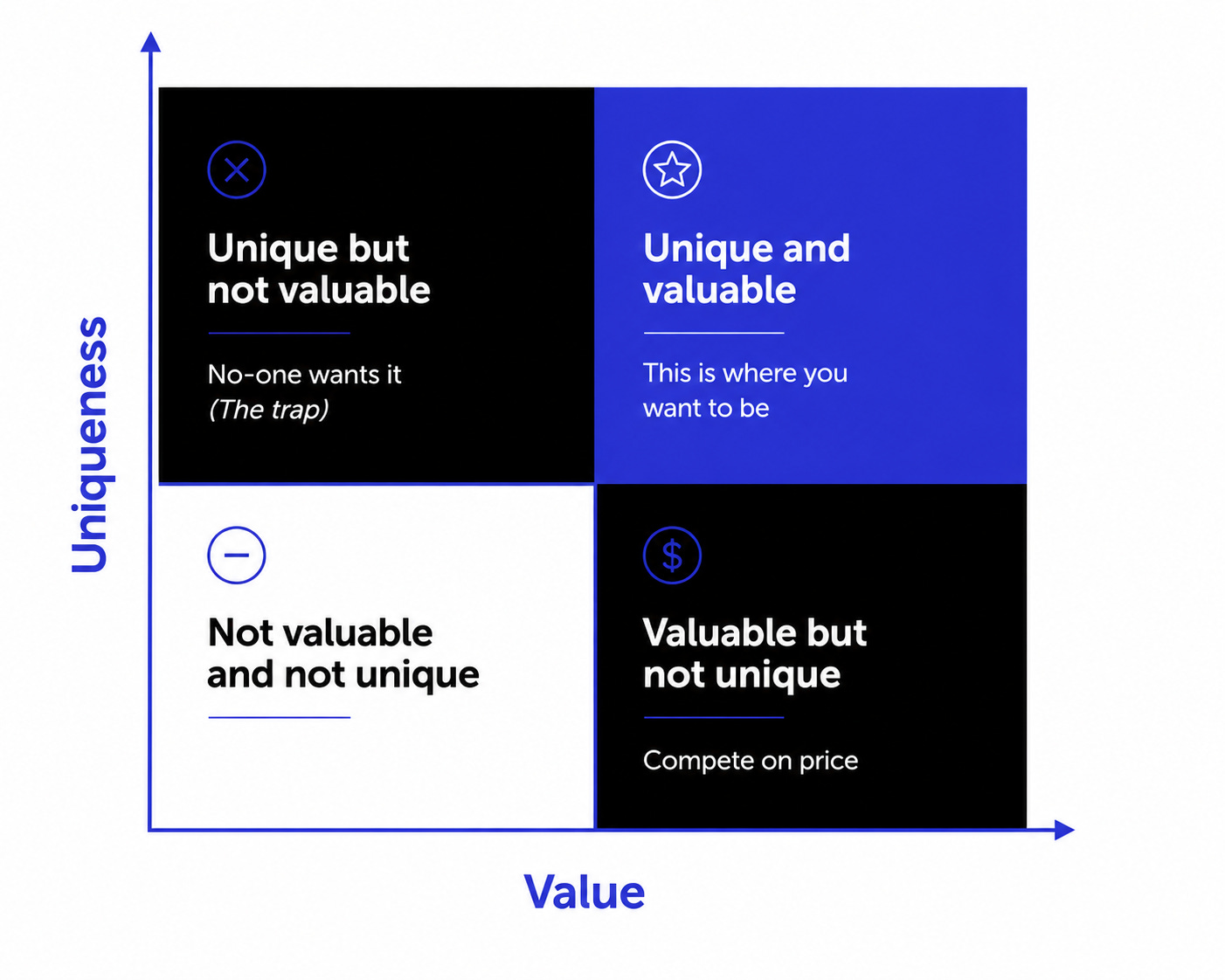
The interesting territory is where both meet.
His example is the original iPod.
It was not simply a music player.
It combined capacity, usability, legal access to music, pricing and Apple’s ecosystem in a way competing products did not.
That is what made it difficult to substitute.
5. Nobody knows the future. Take your best shot.
Guy is skeptical of the mythology surrounding venture capital.
He argues that investors often explain their successful investments as though they were obvious in advance, while failures get rationalized away.
His metaphor is memorable:
“You can always hit the bullseye if you paint the bullseye after you see what’s stuck in the wall.”
There is no perfect dataset, model or investment thesis that removes uncertainty.
The same principle applies to founders.
Guy’s surfing analogy captures it better than any business framework.
You can make the wrong decision about a wave and still find a way to ride it.
That leads to perhaps the most useful idea in the conversation:
Don’t obsess over making the perfect decision. Focus on making your decision right.
You will never have complete information.
You still have to act.
And there is one principle Guy believes could survive another hundred years:
“You should never ask people to do something that you yourself would not want to do.”
Technology will change.
Markets will change.
Products will change.
That test probably won’t.
Timestamps
00:00 Introducing Guy Kawasaki
01:06 Myths and Realities of Startup Success
03:41 What Entrepreneurs Should Optimize For Besides Growth
07:51 Remarkable Use of AI in Product and Code Generation
09:20 From Customer Acquisition to Building Believers
13:43 Starting Over in Silicon Valley Today
15:21 The Influence of Psychology and Behavioral Economics
17:07 Crazy Ideas That Will Be Obvious in the Future
19:04 Silicon Valley's Unique Culture and Its Future
20:31 The Second Half of the 21st Century and AI Startups
22:19 The Reality of Investing in Unproven Startups
25:37 The Importance of Unique and Valuable Products
29:23 The Commoditization of AI Tools
35:24 The Value of Personal Preparation and Research
39:38 Influences of Steve Jobs and Jane Goodall
41:04 Personal Goals and Continuous Improvement
44:29 Timeless Principles of Entrepreneurship
Links
Follow Guy
LinkedIn · Substack · Instagram · X · YouTube
Guy Kawasaki
Website · Remarkable People Podcast · Books
Follow Petar
LinkedIn · Substack · Instagram · X · YouTube
Guy has also made his book Everybody Has Something to Hide available as a free download. You can access it directly from his website.
Final Thought
Guy doesn’t pretend to know what comes next.
That’s part of the point.
You don’t need perfect information.
You need something worth building, enough humility to listen to the people using it, and the willingness to make your decision right after you have made it.
Continue Exploring the Frontier
If this piece resonated, you may want to go deeper.
This article is part of our 22nd Century Frontier Show collection, where we explore ideas, frameworks, and strategies alongside the leaders shaping the next era of entrepreneurship and investment for the 22nd Century.
You can also explore our main topic categories to discover more insights across entrepreneurship, venture capital, fundraising, company building, and frontier technologies.


