


Founders fall in love with their product.
They engineer neat features, polish UX, and ship elegant demos.
But customers buy results, not gadgets.
If your offering does not match a real, named business pain,
it will be ignored,
downgraded to a feature,
or deleted from someone’s phone.
This article explains how to shift your thinking from building cool things to delivering measurable outcomes.
It includes practical tests, quick visual ideas you can use to brief designers, and short examples to make the point.

Sponsor Highlight: EuphoriaTech Group ✨
Your next growth sprint shouldn’t be guesswork. EuphoriaTech Advisory pairs founder-level strategy with hands-on execution to help startups and executive teams scale faster and smarter.
What they’re offering this week:
• Focused 30-minute 1:1 consultations — tactical, no-fluff sessions on Business Strategy & Scaling, Venture Capital Investments, LinkedIn Growth & Personal Brand, or any founder topic.
• Actionable outcomes: leave with prioritized next steps, a short roadmap, and testable experiments you can implement immediately.
• Who it’s for: founders, investors, senior operators, and execs seeking candid, practical guidance.
Key Takeaways
Name the pain, don’t ship the feature
If you cannot describe the buyer’s problem in one sentence, you are building a feature, not a business.Aspirin beats Vitamin every time
Solve urgent, monetizable pain that customers will pay to fix now, rather than nice-to-have improvements.Test willingness to pay before you build heavy tech
Run a priced pilot or sell a paid proof of concept to validate demand faster and cheaper than months of engineering.Translate features into measurable outcomes
Every feature must map to a quantifiable business result - dollars saved, hours recovered, penalties avoided.Scale the problem, not the product
Large markets matter only if the pain is shared and intense. If acquisition requires teaching the market, the economics will be hard.
Table of Contents
1. Stop Selling Your Solution First
Too many startup teams reverse the order.
They build, then ask users to find a use for what they made.
That rarely works.
Instead, start with a specific, repeatable business problem.
Describe it in a single sentence.
Give it a name.
People relate to named problems.
They recognise them, talk about them, and will pay to have them fixed.
2. Pain Is Either Aspirin Or Vitamin
Ask whether your idea is:
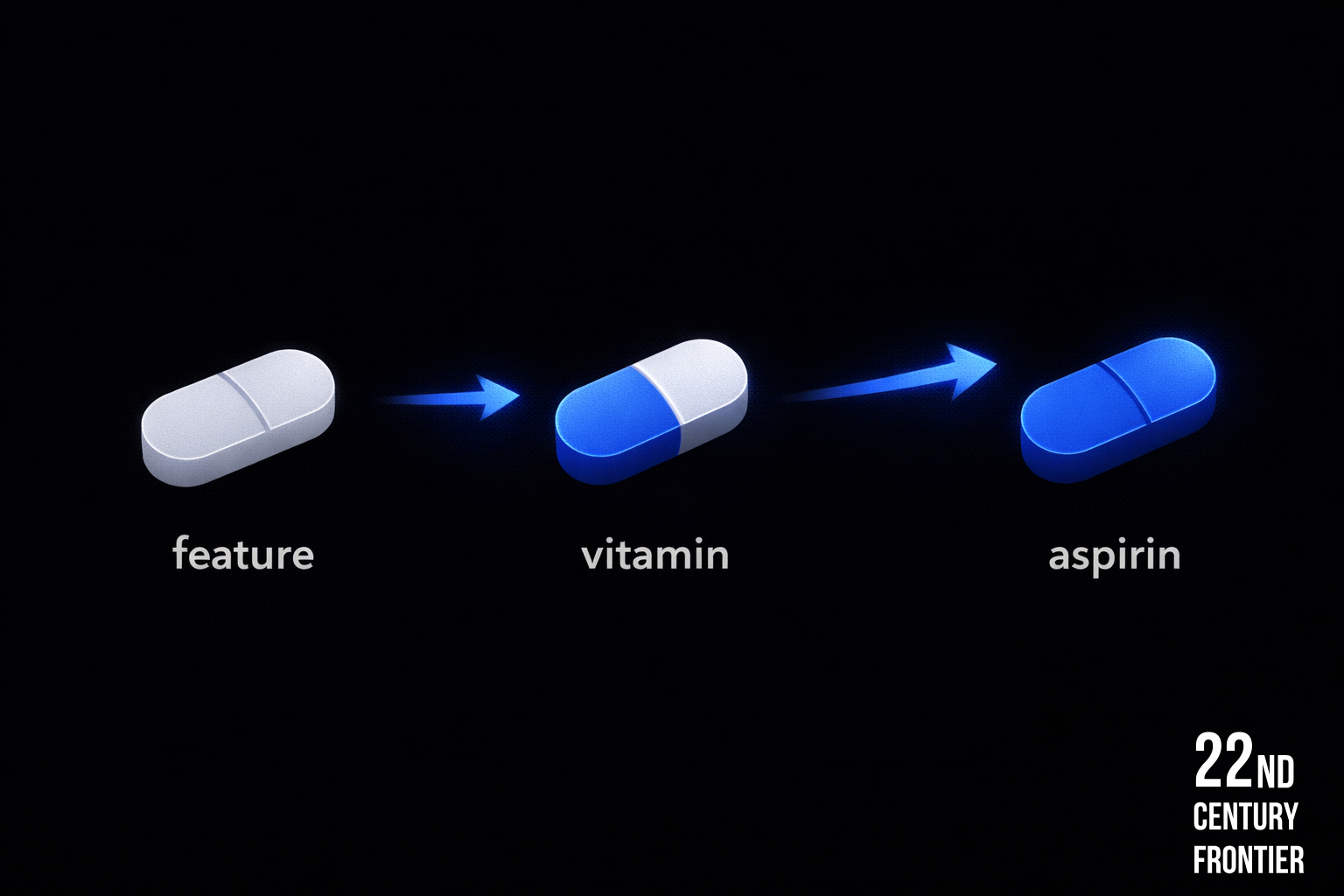
an Aspirin - something people stop everything to buy when the pain spikes
or
a Vitamin - nice to have but easily ignored.
Aspirins win markets.
Vitamins collect dust.
Quick checklist to classify your idea:
Would a finance director cut a purchase order right now to fix this pain?
Does the problem cost the buyer money, time, or reputation?
Is the pain common enough to scale?
If answers are mostly no, you are probably building a vitamin.
Either pivot to a deeper problem, or accept a niche play.
3. Name The Job Your Customer Hires Your Product To Do
Customers do not buy products, they hire outcomes.
Translate your feature list into the job statement.
Example job statement:
“When compliance officers need to prove audit readiness in under 24 hours, they hire X to produce a single, certifiable compliance pack.”
If you cannot write that sentence, keep digging.
Real-world example:
Companies like Calendly succeeded because they turned a blurry admin chore into a crisp job:
Reduce meeting-scheduling friction and recover billable hours.
4. Test Willingness To Pay Before You Build The Shiny Bits
Words are cheap. Money is proof.
Five fast validation steps:
Create a one-page offer and price it.
Run targeted outreach to 30 qualified buyers.
Ask for payment or a committed pilot. If they say yes, you have signal.
If no, ask why and iterate the job statement.
Repeat until conversion is repeatable.
This is cheaper than a six-month build, and more honest.

5. Features Fund Benefits, Not The Reverse
A feature list explains what your product has.
Benefits explain what it does for the buyer.
Translate every feature into a clear benefit, and then into a measurable outcome.
Bad:
“We provide real-time notifications.”
Better:
“We reduce time-to-resolution for ops incidents by 45 percent, cutting penalty fees.”
Buyers buy outcomes. Build features only to deliver those outcomes.
Example:
A payments startup that became viable in a hard market did not sell low-latency rails.
It sold cashflow certainty for seasonally cyclical merchants.
That is a business problem, and merchants paid for it.
If you want a modern example of a payments company reframing value, see Wise.
They shifted the conversation from “cheap transfers” to “transparent predictable cashflow” and gained traction.
6. Scale The Problem, Not The Product
A large addressable market matters, but only if the pain is real.
Small but intense pains can be worth building for, provided the intensity is high.
But avoid the trap of tailoring your product to dozens of tiny frictions that add up only to a trivial business case.
Ask:
If you captured 10 percent of the market, would the business be meaningful?
Does acquisition scale without huge education costs?
Are there natural channels where the buyer already looks for solutions?
If the answers are no, you must either find a partner channel or a deeper problem.
7. Narrative Shapes Adoption
People buy stories.
The product is the proof.
Wrap your outcomes in a narrative that makes it easy to explain to colleagues and bosses.
The best narratives answer three questions:
What is the pain called?
What does the cure look like?
How will the buyer measure success?
Make the narrative repeatable and short enough to fit in an elevator pitch.

8. Final Checklist: Is Your Solution A Business Problem?
Before you code another screen, run this checklist:
Can you name the pain in one sentence?
Will a buyer pay now to stop it?
Can you measure the outcome in dollars, hours, or risk avoided?
Can you test payment in under 30 days?
Is the problem shared by enough companies to scale?
If you fail one or more checks, you are building a feature.
Go back to the job, iterate, and retest.
9. Closing Thought
The best products solve named problems at scale and translate features into outcomes people will pay for.
Move from clever to valuable.
Ship fewer features and more results.
That is how you turn engineering effort into a business people decide to buy.
Continue Exploring the Frontier
If this piece resonated, you may want to go deeper.
Here are three recent articles readers found especially useful:


Each one tackles a different part of the same challenge: building with intent, not hope.
If you are serious about shaping the future rather than reacting to it, you are exactly where you should be.
WHY SUBSCRIBE | PREMIUM RESOURCES | ENTERPRISE PLAN | ADVERTISE
Problem definition before solution proposition. Aspirin provision before vitamin supplements. Some wonderful pointers here, Petar. Featuring this piece in the community reads section in our next piece.✨
Obsession about markets, buyers, users pain - this is the way